


A Guide to Write with Perspective, Voice, and Cultural Insight
I’ve written over 100 restaurant reviews across 15 years, spanning local neighborhoods to international dining rooms, and somewhere along the way I realized most people aren’t taught how to write about food in a way that actually gets published. This isn’t just about taste or opinion; it’s about perspective, context, and knowing how to translate a moment into something that carries weight beyond the plate. What follows isn’t theory, but a distillation of what actually works when you’re trying to move from writing for yourself to writing for publication.
The first meal in a new city is never just about taste; it is about memory, identity, and belonging. For most, it passes quietly. A table for one. A quick decision. A necessary pause in the middle of transition. But for a writer, that moment holds something far more valuable: material. Not just content, but perspective.
Because in today’s editorial landscape, no one is looking for another generic restaurant review. What editors want, what readers remember, is writing that understands food as something larger than the plate. They want story. Context. Meaning. And your first meal is where that begins.
TIP
Start Where It Matters: The Emotional Entry Point
Before you describe a dish, understand your relationship to it. Travelers, and new residents instinctively seek familiarity through food. It’s not indulgence; it’s grounding. A flavor can reconnect you to a place, a memory, a version of yourself that feels distant. This is your entry point as a writer.
The mistake most beginners make is starting with evaluation:
Was it good? Was it worth it?
The better question is:
Why did this meal matter to me in this moment?
That shift from judgment to meaning is what separates a blog post from a publishable piece.
Because strong restaurant writing doesn’t just tell the reader what happened. It tells them why it mattered.
TIP
Read the Room Before You Review the Plate
A restaurant does not exist in isolation. It belongs to a neighborhood, a community, a cultural rhythm that shapes everything from the menu to the atmosphere.
Understanding this is non-negotiable.
Before you write, observe:
- Who is dining here and why?
- What language fills the room?
- What story does the space tell before the food even arrives?
Cities are layered, and their food scenes reflect that complexity. Certain neighborhoods act as anchors for diasporic communities. Restaurants in these spaces often carry histories of migration, adaptation, and preservation.
If you ignore that context, your review will feel flat.
If you capture it, your writing gains depth.
Because you are not just reviewing a meal you are documenting a place within a cultural ecosystem.
TIP
Move Beyond Taste: Write with Dimension
Taste is expected. Dimension is what earns attention.
Professional food writing engages the full experience. It translates sensory input into language that feels precise, intentional, and immersive.
At minimum, your review should capture:
- Taste: Not just flavor, but structure: balance, texture, progression
- Smell: The first impression that sets expectation
- Environment: Energy, sound, pacing, intimacy
- Aesthetic: Presentation, design, visual storytelling
- Emotion: The internal response: comfort, surprise, disconnect
This multidimensional approach reflects professional review standards and elevates your work beyond surface-level commentary.
If your writing only tells the reader what something tastes like, you’ve only told half the story.
TIP
Where Your Voice Lives: Comfort and Displacement
The most compelling food writing often lives in tension.
A dish might remind you of home; but not completely. Something is slightly different. An ingredient replaced. A technique adapted. A flavor that almost lands where you expect it to.
This is not a flaw. This is narrative.
Too many writers chase “authenticity” as a fixed standard. But food, especially in cities shaped by migration, is constantly evolving.
Instead of asking whether something is authentic, ask:
- What has changed?
- What does that change reveal about this place?
- What does it reveal about you?
Your voice emerges in how you interpret that tension.
That’s where originality lives.
TIP
Learn to Observe Like a Storyteller
To write well about restaurants, you need to stop behaving like a passive customer.
Pay attention to what others overlook:
- The pacing of service
- The rhythm of the kitchen
- The details of plating and presentation
- The subtle choices in menu language
Every element is intentional or revealing in its absence. The strongest writers don’t just consume experiences. They decode them.
And that skill, observation layered with interpretation is what editors look for.
TIP
Your Opening Line Is Already There
Every review needs a hook. Most writers overthink it.
You don’t need to invent one. You just need to recognize it.
It’s in the first bite.
That moment when expectation meets reality when something either connects or doesn’t is your entry point.
Instead of opening with information, open with tension.
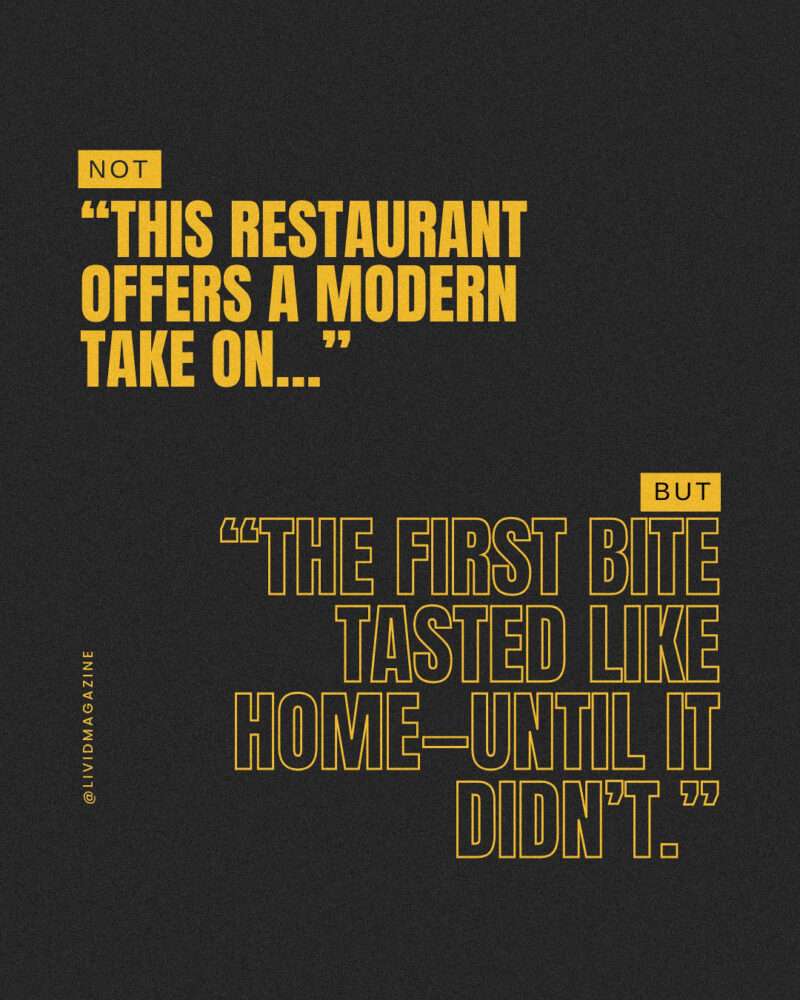
That line does more than describe. It invites.
It signals that the reader is about to experience something, not just read about it.
TIP
Write for the Publication, Not Just Yourself
Good writing alone does not get published. Relevant writing does.

Before pitching or submitting:
-
Study the publication’s tone and structure
-
Understand its audience
-
Align your perspective with its editorial pillars
For platforms like LIVID, that means combining cultural relevance, visual awareness, and narrative sophistication within the SAVORY space.
Your voice should feel distinct; but it should also feel like it belongs.
TIP
Your First Assignment Starts Now
If you’re waiting for permission to start writing, you’re already behind.
Your next meal is your first assignment.
Approach it with intention. Pay attention to what you feel, not just what you taste. Write it down while it’s still fresh before it becomes memory instead of experience.
Because the truth is, no one remembers the most technically perfect review.
They remember the one that made them feel something.
And that starts with you learning how to see a meal not just as food, but as story, context, and identity.
Because sometimes, the first place you belong in a new city isn’t a neighborhood; it’s a flavor.
Related content
You’ve just read how to write a restaurant review that actually gets published now it’s your turn to put it into practice. I have created the exact Restaurant Review Template and Pitch Email Template used to structure and submit publishable work.
To get access, head to my latest post on Instagram and comment WRITE—I will send everything directly to you.
Because the difference between reading about it and getting published starts with taking that first step.
What's Your Reaction?


